Attractions

Mountain Resort

Mountain Resort

Recommend 4.7 / 5

Work began in 1703, the 42nd year of the Kangxi reign, and was not completed until 1792, the 57th year of Qianlong, taking 89 years across three reigns. The grounds cover 564 hectares, and the palace wall follows the slope for about ten kilometres — the largest surviving imperial garden in the world. Hills make up about four fifths of the estate, while the lake district holds eight lakes of various sizes; Kangxi and Qianlong each titled thirty-six views, together forming the seventy-two. The main hall, Danbo Jingcheng Hall, stands on 48 great nanmu columns. The Qing court received the returning Torghut leader Ubashi and the visiting Sixth Panchen Lama here. Listed as a national key cultural relic in 1961, the resort entered the World Heritage List in 1994 as the Mountain Resort and its Outlying Temples. Highlights include the Danbo Jingcheng Hall, Yanyu Tower, Rehe Spring and the Mongolian yurts. Tip: Allow half a day; electric carts run inside the scenic area. Summer is best for escaping the heat, and the autumn foliage should not be missed. Practical info: located at 6 Shanzhuang East Road, Shuangqiao District, Chengde, Hebei Province; admission ¥130 (peak season); open 07:00–18:00.

Tip: Allow half a day for the visit; electric carts are available within the scenic area.
  • Address: 6 Shanzhuang East Road, Shuangqiao District, Chengde, Hebei Province
  • Ticket: ¥130 (peak season)
  • Opening: 07:00–18:00
Mountain Resort
Mountain Resort
Mountain Resort
Puning Temple

Puning Temple

Recommend 4.7 / 5

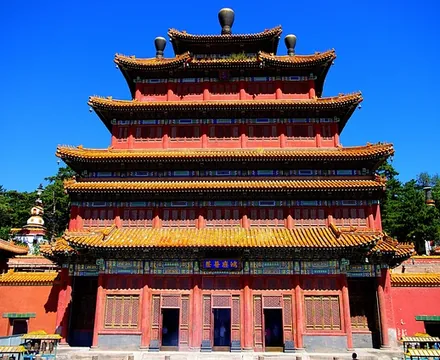
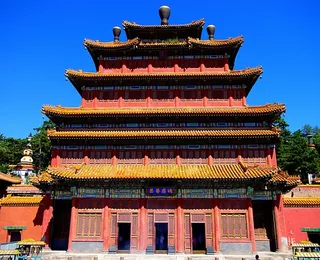
Puning Temple was first built in 1755, the 20th year of the Qianlong reign, to commemorate the pacification of the Dzungars, its name meaning 'universal peace'. The front half follows the Han-style seven-hall monastery layout, while the rear centres on the Tibetan-style Mahayana Hall, forming a Han-Tibetan composition. The Mahayana Hall is 36.75 metres high and houses a wooden thousand-armed, thousand-eyed Guanyin 22.28 metres tall, carved from pine, cypress, elm, linden and fir — one of China's largest surviving wooden Guanyin statues. A Han-Tibetan temple built by Qianlong to commemorate the pacification of the Dzungars, whose Mahayana Hall houses a 22.28-metre thousand-armed Guanyin, one of China's largest wooden Guanyin statues. Compared with the other Outer Eight Temples, both its incense and the scale of its architecture are more striking. Highlights include the Han-Tibetan layout and the Qianlong stele. Tip: It is on the same route as the Mountain Resort, so visit Puning first in the morning; photography is forbidden inside the halls, and religious etiquette should be respected. Practical info: located at 1 Puning Road, Shuangqiao District, Chengde; admission ¥80 (peak season; subject to official notice); open 08:00–17:30.

  • Address: 1 Puning Road, Shuangqiao District, Chengde
  • Ticket: ¥80 (peak season; subject to official notice)
  • Opening: 08:00–17:30
Puning Temple
Puning Temple
Puning Temple
Putuozongcheng Temple

Putuozongcheng Temple

Recommend 4.7 / 5

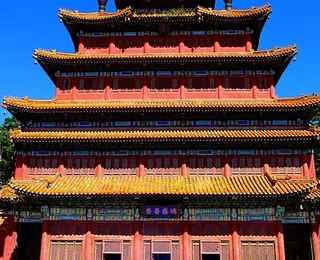
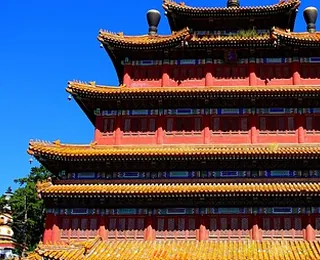
Construction began in 1767, the 32nd year of the Qianlong reign, and was completed in 1771, the 36th year, to mark the Qianlong Emperor's 60th birthday and the empress dowager's 80th. The temple covers 220,000 square metres and contains about 60 buildings, rising in stages from the mountain gate, stele pavilion and Five-Stupa Gate to the glazed archway. At the rear the Great Red Platform stands 43 metres high; its outer wall appears to have seven storeys but inside there are three tiers of galleries around the central Wanfa Guiyi Hall, whose roof is covered with gilded fish-scale copper tiles. In the Qing dynasty twelve Tibetan Buddhist temples were built around the resort, eight of them administered by officials of the Lifanyuan and commonly called the Outer Eight Temples; they joined the World Heritage List with the Mountain Resort in 1994. Known as the Little Potala Palace, it copies Tibet's Potala Palace, with red and white platforms rising in tiers, and is the largest temple among the Outer Eight Temples. Tip: Combine it with the Mountain Resort on a joint ticket to learn about Qing ethnic policy and religious culture. Practical info: located on Huancheng North Road, Shuangqiao District, Chengde, Hebei Province; admission ¥80; open 08:00–17:30.

Tip: Best combined with a Mountain Resort ticket to understand Qing ethnic policy and religious culture.

  • Address: Huancheng North Road, Shuangqiao District, Chengde, Hebei Province
  • Ticket: ¥80
  • Opening: 08:00–17:30
Putuozongcheng Temple
Xumifushou Temple

Xumifushou Temple

Recommend 4.5 / 5

The whole temple rises in stages with the hillside, covering 37,920 square metres, and was built on the model of Tashilhunpo Monastery, the Sixth Panchen Lama's seat at Shigatse in Tsang. At the front is a Han-style glazed archway of three bays, four columns and seven roof tiers, followed by a stele pavilion whose imperial tablet is inscribed in Manchu, Chinese, Mongolian and Tibetan. The Miaogao Zhuangyan Hall is where the Sixth Panchen Lama preached; its roof is covered with gilded fish-scale copper tiles, said to have used more than 11,500 taels of gold, and eight gilded dragons of about a tonne each sit on the ridges — hence the temple's popular name, the Panchen Lama's Palace. In 1994 it was inscribed with the resort and the other surrounding temples on the World Heritage List. A Tibetan-style temple built in 1780 by the Qianlong Emperor to welcome the Sixth Panchen Lama and mark his own 70th birthday; the Miaogao Zhuangyan Hall has a dazzling gilded roof, a fusion of Han and Tibetan art. Tip: Visit it together with Putuozongcheng Temple to experience Tibetan Buddhist culture. Practical info: located on Huancheng North Road, Shuangqiao District, Chengde, Hebei Province; admission ¥80; open 08:00–17:30.

Tip: Can be visited together with Putuozongcheng Temple to experience Tibetan Buddhist culture.

  • Address: Huancheng North Road, Shuangqiao District, Chengde, Hebei Province
  • Ticket: ¥80
  • Opening: 08:00–17:30
Xumifushou Temple
Xumifushou Temple
Xumifushou Temple
Qingchui Peak (Hammer Peak)

Qingchui Peak (Hammer Peak)

Recommend 4.4 / 5

The pillar is made of calcareous sandstone; long weathering and flowing water broke down the rock on every side until only this shaft was left standing on the ridge. The Kangxi Emperor, seeing in it the mallet that strikes a temple chime, gave it the name Qingchui Peak, though local people still use the old name, Hammer Peak. The slopes below are now a national forest park with continuous woodland, rated a national AAAA tourist attraction. Barely 2.5 kilometres from the city centre, it is an ordinary local outing for a climb and for autumn leaves. Baoshan Temple stands 200 metres north of the peak, and about 500 metres south is the Toad Stone; legend says Yu the Great used an iron rod to subdue a troublesome toad spirit, which is why the two stones face each other across the distance. Chengde's signature rock pinnacle — a huge stone thicker at the top and narrower below like a mallet, standing on the ridge, with a cable car offering views over the resort. Highlights include the Qingchui Peak viewing platform, the cable car and the sunset. Tip: Go towards evening to enjoy the sunset and the resort lights after dark. The cable car round trip takes about 30 minutes. Practical info: located in Qingchui Peak National Forest Park, Shuangqiao District, Chengde, Hebei Province; admission ¥50; open 07:30–17:30.

  • Address: Qingchui Peak National Forest Park, Shuangqiao District, Chengde, Hebei Province
  • Ticket: ¥50
  • Opening: 07:30–17:30
Qingchui Peak (Hammer Peak)