Attractions

Hongyadong

Hongyadong

Recommend 4.6 / 5

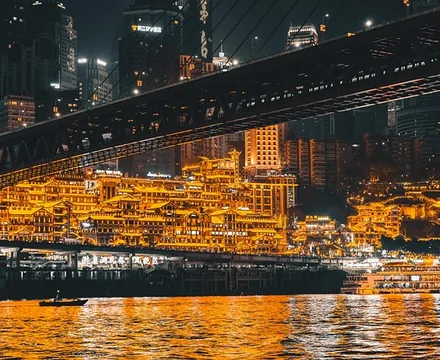
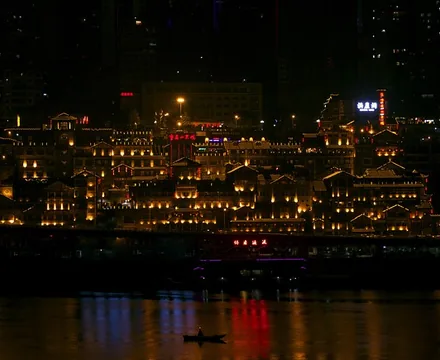
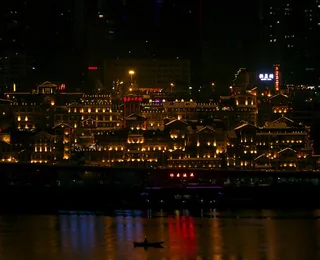
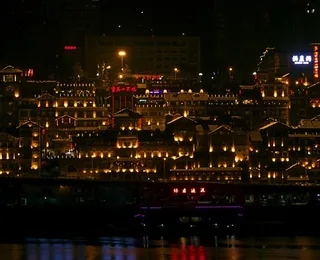
The cliff where Hongyadong stands was a key point on the city's northwest approach since ancient times: military works stood here as early as the Warring States period, and cave temples cut into the hillside appeared in the Song dynasty. From the Ming and Qing onward, stilted houses crowded the riverbank and boats filled the wharves, and 'Dripping Green at Hongya' was one of the old Twelve Scenes of Ba-Yu. When the Ming commander Dai Ding rebuilt Chongqing's stone walls, he established seventeen gates — nine open and eight closed — and Hongya Gate was one of the closed ones, a name the place still carries. The district was rebuilt as a whole at the start of the 21st century and opened in 2006, covering about 31,500 square metres; the buildings climb eleven storeys along the cliff to a total height of 79 metres, with about 75 metres between Cangbai Road at the top and the Jialing riverside road at the bottom — hence the wonder of 'the top floor opens onto a road and the ground floor opens onto a road too'. Now a 4A scenic area, it is brightly lit after dark, and the opposite riverbank and Qiansimen Bridge are the traditional vantage points for a full view. Highlights include the stilted houses at night, the Ba-Yu Folk Street, the viewpoint over the meeting of the two rivers and the Hongyadong snack street. Tip: Go towards evening and wait for the moment the lights come on — the most spectacular sight. Practical info: located on Jiabin Road, Yuzhong District, Chongqing; admission free; open all day.
  • Address: Jiabin Road, Yuzhong District, Chongqing
  • Ticket: Free
  • Opening: All day
Hongyadong
Hongyadong
Hongyadong
Ciqikou Ancient Town

Ciqikou Ancient Town

Recommend 4.4 / 5

Ciqikou was founded in the Song dynasty and grew into a town because of its position on the Jialing River. It was first called 'Baiyan chang' and later 'Longyin zhen'; tradition says that after the Jingnan upheaval the Jianwen Emperor, Zhu Yunwen, hid at the town's Baolun Temple, hence 'Longyin' (Hidden Dragon). In the Qing dynasty, porcelain fired around Qingcaopo was loaded onto boats here, and the name 'Ciqikou' (Porcelain Port) became the common one. In the Republican era it was a major centre of Jialing shipping and a collection point for goods from eastern Sichuan, with salt firms, merchant guilds, workshops and guild halls crowded together, earning the name 'Little Chongqing'; after river transport declined, the old town kept its layered layout along the hill and river. The cobbled main street connects with several slanting lanes and stone steps, lined mostly with chuandou-frame wooden houses and shopfronts from the Ming and Qing onward; Baolun Temple and the Zhong Family Courtyard preserve the original settings of old Chongqing's daily life and trade. The town's Chen Mahua, maoxuewang and dried bean-curd skin, along with Sichuan opera sung in teahouses, qingyin singing and storytelling, have all been passed down. Tip: Weekdays are better; the main street is lively, but the back streets feel more like old Chongqing. Practical info: located at Ciqikou, Shapingba District, Chongqing; admission free; open all day.
Tip: Visit on weekdays for a better experience.

  • Address: Ciqikou, Shapingba District, Chongqing
  • Ticket: Free
  • Opening: All day
Ciqikou Ancient Town
Yangtze River Cableway

Yangtze River Cableway

Recommend 4.5 / 5

The Yangtze River Cableway opened in 1987, crossing the river between Xinhua Road in Yuzhong District and Shangxin Street in Nan'an District along a total length of 1,166 metres; it has long been called 'the first aerial corridor over the Yangtze'. Each cabin holds about 80 passengers and runs at roughly 6 metres per second, so a crossing takes only about four minutes. In the years when river bridges were still few, the cableway was the public transport people took to work and to market, and daily ridership was once very large; after an upgrade completed at the end of 2019 it reopened, with commuting receding and sightseeing taking the lead. As the cabin crosses the water you look down on the skyline of the two rivers' four banks and the stacked buildings of the Yuzhong Peninsula, the view best at dusk as the lights come on; the slight shudder as the cabin starts and the cables take the load preserves the mechanical feel of an old aerial tramway. Highlights include the flight across the river, the panorama of the Yuzhong Peninsula, the night view of the two rivers and the three-dimensional mountain city. Tip: Ride at dusk to see both the sunset and the lights coming on. One way is enough; no need to return. Practical info: located on Xinhua Road, Yuzhong District, Chongqing; ticket ¥20 one way; open 07:30–22:30.

  • Address: Xinhua Road, Yuzhong District, Chongqing
  • Ticket: ¥20 one way
  • Opening: 07:30–22:30
Yangtze River Cableway
Chongqing China Three Gorges Museum

Chongqing China Three Gorges Museum

Recommend 4.8 / 5

The Chongqing China Three Gorges Museum traces its roots to the Southwest Museum founded in 1951; the new building opened in 2005, facing the Great Hall of the People across the square. It holds more than 280,000 objects, with permanent exhibitions including 'Magnificent Three Gorges', 'Ancient Ba-Yu', 'Chongqing: The City's Road' and 'The War Years'. Finds from the Three Gorges, Ba-Shu bronzes, Han pictorial stones and wartime objects are the highlights. A provincial-level museum directly opposite the Great Hall of the People, strong on Three Gorges relics, Ba-Yu history and the war years. Free with reservation, it is the best complement to Hongyadong for understanding Chongqing's character. Highlights include 'Magnificent Three Gorges', 'Ancient Ba-Yu', 'The War Years' and the Great Hall of the People. Tip: Enter after booking, see the Three Gorges and Ba-Yu first, then look at the exterior of the Great Hall; allow at least 2–3 hours. Practical info: located at 236 Renmin Road, Yuzhong District, Chongqing; admission free (reservation required); open 09:00–17:00 (closed Mondays; last entry 16:00). Best season: spring (Mar–May) and autumn (Sep–Nov) are pleasant; summers are hot but the night scenery is dazzling.

  • Address: 236 Renmin Road, Yuzhong District, Chongqing
  • Ticket: Free (reservation required)
  • Opening: 09:00–17:00 (closed Mondays; last entry 16:00)
Chongqing China Three Gorges Museum
Wulong Tianlong Three Bridges

Wulong Tianlong Three Bridges

Recommend 4.7 / 5

Wulong Karst was inscribed in 2007 on the World Natural Heritage List as part of South China Karst, and the Three Natural Bridges share that property with Furong Cave and the Houping erosion sinkholes. The core of the site consists of three natural stone arches — Tianlong, Qinglong and Heilong bridges — with the Tianlong and Shenying sinkholes between them, bridges and pits joined end to end in the rare layout of 'three bridges flanking two pits': looking up from the valley floor, the arches hang between cliffs hundreds of metres high, their faces layered with caves, underground river mouths and solution grooves — a readable cross-section of karst evolution. Beneath Tianlong Bridge stands the Tianfu Official Post, a Tang-style relay station rebuilt on the pit floor for the filming of Curse of the Golden Flower, its grey-tiled courtyard in sharp contrast with the sheer walls around it; Transformers: Age of Extinction also filmed among the three bridges. The route descends from the entrance by stone steps along the cliff to the valley floor, then follows the stream out beneath the arches, repeatedly changing your viewpoint between the bridge openings, the pit floor and the walkways. Plan your stay according to opening hours and your energy.

Tip: About 2 hours of walking inside the park — wear comfortable trainers.

  • Address: Xiannüshan Town, Wulong District, Chongqing
  • Ticket: Peak ¥95
  • Opening: 08:00–17:00
Wulong Tianlong Three Bridges
Dazu Rock Carvings

Dazu Rock Carvings

Recommend 4.7 / 5

Large-scale carving at Dazu began in 892, the first year of the Jingfu era at the end of the Tang, when Wei Junjing, prefect of Changzhou, opened the first images at Beishan. Work continued through the Five Dynasties and flourished in the Song, with some later carving in the Ming and Qing, producing a great group of cliff sculptures centred on Baodingshan and Beishan and accompanied by Nanshan, Shizhuan Mountain and Shimen Mountain; it was inscribed on the World Heritage List in 1999. The Great Buddha Bend at Baodingshan was directed by the Southern Song monk Zhao Zhifeng from the age of twenty for more than seventy years: the U-shaped ravine runs about 500 metres, with niches along the cliff and nearly 10,000 figures, among them the 31-metre reclining Buddha of the Nirvana scene, which enters the rock only as a half figure and leaves the rest to the imagination, and the 7.7-metre Thousand-Armed Guanyin niche, which underwent major conservation between 2008 and 2012. At Beishan, the openwork stone repository of the Dharma-Wheel Sutra Chamber and the fully carved Guanyin show the Song carvers' method at its most refined. The sutra tableau on parental kindness, the hell tableau and the Wheel of the Six Realms turn Confucian filial duty and karmic retribution into continuous picture stories — the summation of Buddhist art's Chinese and worldly transformation.

Tip: The carvings are spread across several cliffs in Dazu; Baodingshan and Beishan are the highlights and lie clos…

  • Address: Dazu District, Chongqing (about 1.5–2 hours by road from the central city)
  • Ticket: Baodingshan + Beishan combo about ¥115
  • Opening: 08:30–17:30 (last entry about 17:00)
Dazu Rock Carvings
Dazu Rock Carvings
Dazu Rock Carvings