Longmen Grottoes
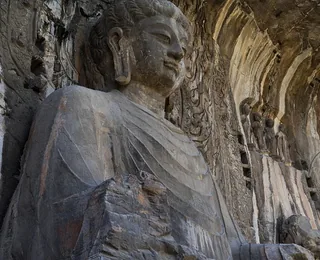
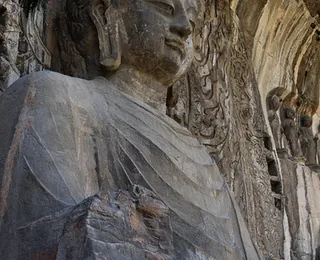
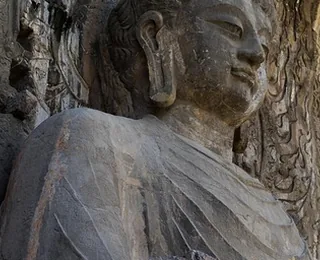
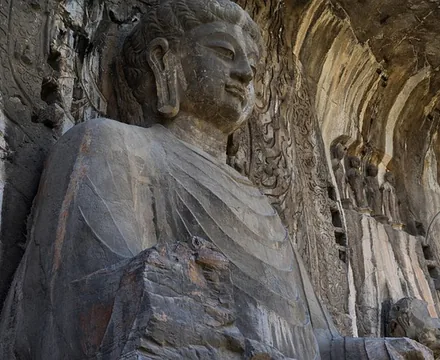
Two hills stand like gates at Longmen with the Yi River flowing between them; the place was anciently called Yique, and it took the name "Dragon's Gate" after the Sui built their eastern capital, whose principal southern gate faced the opening directly. Carving began when Emperor Xiaowen of Northern Wei moved the capital to Luoyang (493 AD) and continued for more than four centuries through the Eastern Wei, Western Wei, Northern Qi, Sui and Tang. Today 2,345 numbered caves and niches, nearly 110,000 statues and more than 2,800 stelae and inscriptions survive. On the west cliff, the Great Vairocana Niche of Fengxian Temple was begun in the third year of the Xianheng era of Tang Gaozong (672 AD), and Wu Zetian contributed "twenty thousand strings of cosmetic money"; nine figures are grouped around the Vairocana Buddha, which stands 17.14 meters tall, and the stele recording the niche's construction, the Record of the Great Vairocana Niche, still remains — a meeting of imperial will and supreme stonework. The Ten Thousand Buddha Cave on the east cliff packs more than ten thousand small Buddhas across its walls, while Northern Wei dedication inscriptions from Guyang Cave and elsewhere on the west cliff were later compiled as the Twenty Longmen Masterpieces, models of Wei-style stele calligraphy. The relief of the Emperor and Empress Worshiping the Buddha at the Binyang Caves was hacked out and dispersed in the 1930s, and today is divided between the Metropolitan Museum of Art in New York and the Nelson-Atkins Museum of Art in Kansas City. In November 2000 Longmen Grottoes were inscribed on the World Heritage List; Xiangshan Temple across the river and Bai Garden on Pipa Peak, where the poet Bai Juyi spent his last years and was buried, are part of the same setting.
Visit in the afternoon, when sunlight falls most beautifully on the Vairocana Buddha.