Terracotta Army
★★★★★Recommend 4.8 / 5
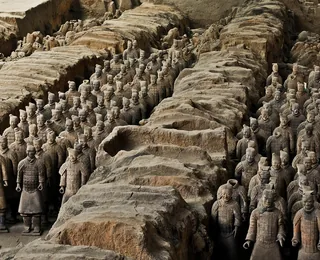
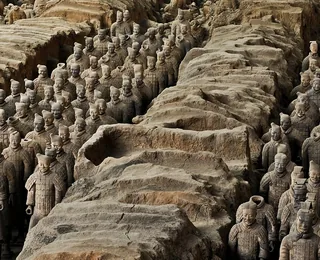
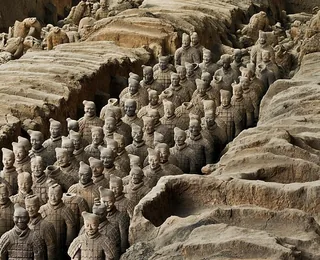
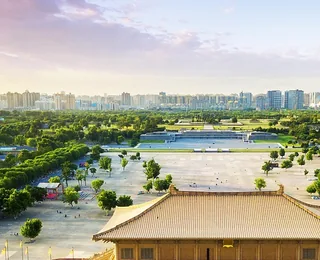
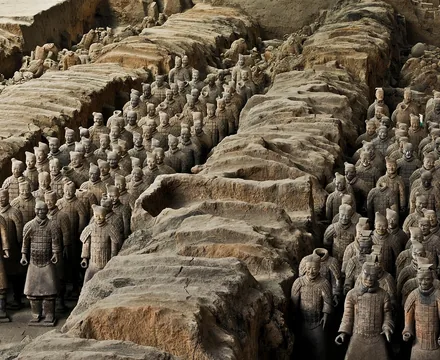
The pits came to light in March 1974, when farmers digging a well at Xiyang Village in Lintong struck pottery shards; subsequent excavation has yielded about 8,000 pottery warriors and horses. Pit 1 is by far the largest — 230 m long east to west and 62 m wide, roughly 14,200 square metres, with more than 6,000 figures: a vanguard rank lines the eastern end, behind it a dense formation of chariots and infantry. Pit 2 covers some 6,000 square metres and interleaves crossbowmen, cavalry and chariots; the Kneeling Archer and the senior officer figures (popularly 'generals') come from it, while the tiny Pit 3 — 520 square metres with only 68 figures — is generally read as the army's command post. The warriors average about 1.8 m in height and were originally fully polychrome, pigments such as cinnabar and malachite laid over a raw-lacquer ground; once exposed the lacquer dries, curls and sheds its colour, so conserving the paint remains the hardest part of any excavation. The bronze chariots and horses from the satellite pit west of the mound were cast at exactly half the size of real vehicles and teams. In 1987 the Mausoleum of the First Qin Emperor and its terracotta army pits were inscribed together on the World Heritage List.
Tip: Hire a guide or rent an audio device — otherwise the historical value is hard to grasp. Allow 2–3 hours.
Xi'an City Wall
★★★★★Recommend 4.7 / 5
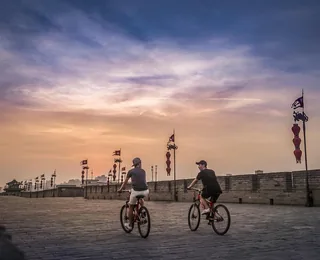
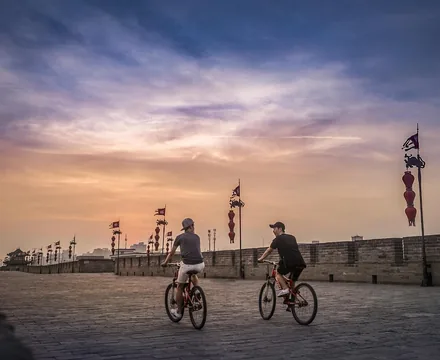
Xi'an's wall was built in the Ming Hongwu era on the foundations of the Tang imperial city: a rammed-earth core of layered loess faced with blue brick; its four cardinal gates were named Changle (Everlasting Joy) to the east, Anding (Spreading Stability) to the west, Yongning (Perpetual Calm) to the south and Anyuan (Projecting Peace Afar) to the north, the names themselves voicing the hope of lasting peace. The circuit measures about 13.74 kilometres and rises 12 metres, with a crest 12–14 m wide and a base 15–18 m wide — broad enough for horse and cart to run along the top. Some 5,984 crenellations and 98 bastions (horse-face projections) are set into the ramparts, and each of the four principal gates is defended by a triple sequence of tower, arrow tower and gatehouse with a barbican; the 18 gates counted today were mostly punctured through the wall in later centuries and especially in the modern era. Yongning, the south gate, has seen the longest continuous use and keeps the most complete layout, while inside the west wall at Hanguang Gate the rammed-earth remains of three Tang imperial-city gate passages survive as direct evidence of the Sui-Tang city plan. Major restoration began in 1983, when a ring park was laid out at the foot of the wall; since then the walkway along the crest has been continuous, which is what makes the full-cycle circuit possible. Highlights include Yongning Gate (South Gate), the Hanguang Gate ruins, cycling the wall and the night illumination. Tip: cycling the wall at dusk is recommended; the old city is especially beautiful in the setting sun. Practical info: located on South Street, Beilin District, Xi'an; ticket ¥54; opening hours 08:00–22:00.
Tip: Cycling the wall at dusk is recommended; the old city is especially beautiful in the setting sun.
Shaanxi History Museum
★★★★★Recommend 4.9 / 5
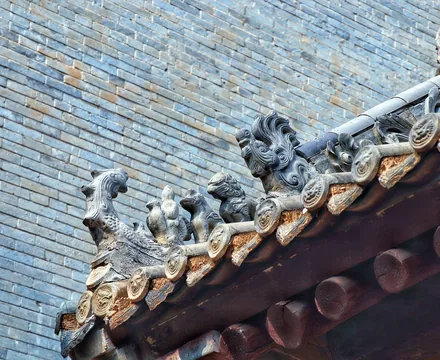
Opened in 1991, the Shaanxi History Museum was China's first large modern national museum and holds over 1.7 million objects. Its permanent galleries focus on the Zhou, Qin, Han and Tang, with Shang and Zhou bronzes, Han pottery figures, Tang gold and silver, and murals forming a complete sequence. The Hejiacun hoard, the Tang mural gallery and the Empress's Seal are highlights. The Tang mural gallery is ticketed separately. Highlights include the Zhou, Qin, Han and Tang permanent exhibition. Tip: free tickets must be booked in advance through official channels and are released quickly in peak season; the mural gallery charges separately. Practical info: located at 91 Xiaozhai East Road, Yanta District, Xi'an; free admission (reservation required, special exhibitions extra); opening hours 08:30–18:00 (closed Mondays, closing may be later in peak season).
Tip: Free tickets must be booked in advance through official channels and are released quickly in peak season; the…
Giant Wild Goose Pagoda
★★★★★Recommend 4.6 / 5
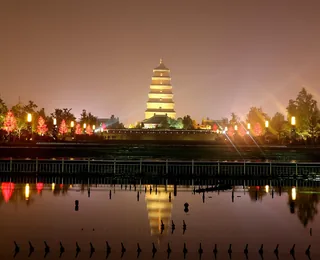
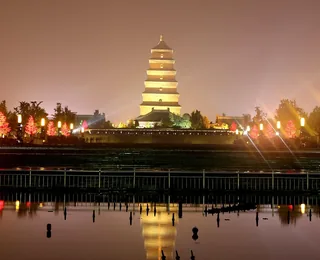
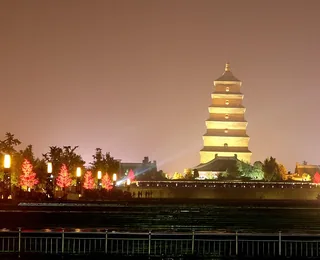
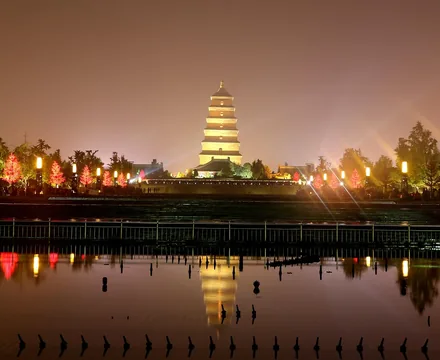
In 648, the 22nd year of the Zhenguan era, Li Zhi — then crown prince — founded the Daci'en (Great Compassion and Favours) Temple to dedicate merit to his mother the Empress Wende, and invited Xuanzang to reside there as head of the translation bureau. In 652, the third year of Yonghui, Xuanzang had a pagoda raised in the temple's west court after Indian stupa models to house the Sanskrit texts, Buddha images and relics he had brought from India. The tower first stood five storeys, and was repeatedly enlarged and damaged down the centuries — the seven-storey brick structure seen today, some 64 metres high, dates in form from the Ming rebuilding. Flanking the south doorway of the ground storey are two steles carrying the preface and note that Emperor Taizong composed for the translated canon, cut in the calligraphy of Chu Suiliang, among the celebrated Tang stone classics. Xuanzang translated sutras here for many years, and the Sanskrit texts he carried back numbered 657. Newly successful candidates in the imperial examinations made a habit of inscribing their names on the pagoda, so 'names inscribed at the Wild Goose Pagoda' became the emblem of scholarly glory in the examination age. In 2014 the pagoda was inscribed on the World Heritage List as a component site of the Silk Roads: the Routes Network of Chang'an–Tianshan Corridor. Highlights include the Xuanzang Tripitaka Hall and the pagoda's south square. Tip: the evening musical fountain and light show are spectacular; arrive early for a good spot. Practical info: located at Ci'en Temple, Yanta District, Xi'an; ticket ¥50; opening hours 08:00–21:30.
Tip: The evening musical fountain and light show are spectacular; arrive early for a good spot.
Datang Everbright City
Datang Everbright City
★★★★★Recommend 4.8 / 5
Datang Everbright City runs about 1.5 km from the south square of the Giant Wild Goose Pagoda to Kaiyuan Square, lined with Tang-style buildings, sculptures and shops. Night is the best time: the illuminated rooflines form a continuous Tang skyline, and free performances — the 'Tumbler Girl', Tang mystery boxes and parades — take place along the street. There is no admission fee, but crowds are huge on holidays and crowd control is common. Highlights include the Giant Wild Goose Pagoda south square, Xuanzang Square and the night street performances. Tip: go after 7 pm, see the musical fountain at the pagoda's north square first, then walk south; there is crowd control on holidays, so use Metro Line 3/4 and Dayanta station where possible. Practical info: located at 46 Ci'en Road, Yanta District, Xi'an (south of the Giant Wild Goose Pagoda south square); free admission; open all day (lights and performances about 19:00–24:00, subject to on-site notice).
Tip: Go after 7 pm, see the musical fountain at the pagoda's north square first, then walk south.
Datang Everbright City
Datang Everbright City
Datang Everbright City
Huaqing Palace
★★★★☆Recommend 4.5 / 5
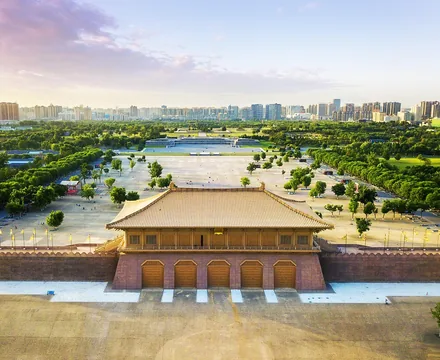
The hot springs at the north foot of Mount Li have been used since the Neolithic villagers of the Jiangzhai settlement; later dynasties kept villa palaces here, and in 747, the sixth year of the Tianbao era, the Tang emperor Xuanzong renamed the Hot Spring Palace as Huaqing Palace, making it the winter retreat where the Tang emperors took warmth, held court and feasted. Excavations from 1982 uncovered five stone-lined imperial pools of the Tang palace, now conserved and displayed in a site museum built over them: the Haitang (Crab-Apple) Pool takes its name from its flower-shaped outline and is traditionally given as Consort Yang's bath, the Lotus Pool — the imperial bath — covers some 400 square metres, while the Star, Crown-Prince and Shangshi pools served users of different rank, and the Tang masonry and hidden drainage channels are still visible at the pool bottoms. Halfway up the mountain the Bingjian (Remonstrance) Pavilion and, on the summit, the beacon tower where King You of Zhou supposedly lit signal fires to amuse his feudal lords compress Western Zhou legend and modern history into a single slope; at its foot the Five-Room Hall is the site of the Xi'an Incident of 12 December 1936, where bullet marks remain clearly visible on the walls and window frames. After dark the open-air spectacle 'Song of Everlasting Sorrow' uses the mountain ridge and the palace buildings as its backdrop, threading pools, beacon fires and the barracks of 1936 into one story. Highlights include the Haitang Pool (Consort Yang's bath), the Five-Room Hall, Mount Li sunset and the 'Song of Everlasting Sorrow' performance. Tip: the performance is highly recommended and tickets should be booked in advance. Practical info: located on Huaqing Road, Lintong District, Xi'an; ticket ¥120; opening hours 07:30–18:30.
Tip: The 'Song of Everlasting Sorrow' performance is highly recommended and tickets should be booked in advance.
Forest of Stone Steles Museum
Forest of Stone Steles Museum
★★★★☆Recommend 4.6 / 5
The 'forest of steles' takes its name from the dense groves of stone slabs set among the courtyards of the former Confucian temple. Its origin is the 1087 prefectural-school hall built to house the Tang Kaicheng Confucian Classics, and the museum itself opened in 1944. Several thousand steles and epitaphs span nearly two millennia, displayed hall by hall and corridor by corridor. Highlights include the twelve Kaicheng Confucian Classics, the Nestorian Stele, Yan Zhenqing's Duobao Pagoda Stele and four of the Six Steeds of Zhaoling. Tip: follow the galleries in order and hire a guide or audio device — the value of a stele lies in the people behind it, not the stone. Practical info: located at 15 Sanxue Street (inside Wenchang Gate), Beilin District, Xi'an; ticket ¥10 (public-benefit rate, reservation required); opening hours 09:00–18:00 (last ticket 17:00, seasonal adjustments).
Tip: Follow the galleries in order and hire a guide or audio device — the value of a stele lies in the people behin…
Forest of Stone Steles Museum
Forest of Stone Steles Museum
Forest of Stone Steles Museum