City Intro

History & Culture: Fuzhou, nicknamed the Banyan City, is the capital of Fujian Province and a national historical and cultural city, located in eastern Fujian along the lower reaches of the Min River. Fuzhou boasts deep cultural roots. The Three Lanes and Seven Alleys is one of China's best-preserved Ming–Qing street quarters, having produced modern luminaries like Lin Zexu and Yan Fu. Mawei's shipyard culture witnessed the birth of China's modern navy. Fuzhou's hot-spring wellness tradition runs deep, and Shoushan stone carving is celebrated at home and abroad. Intangible heritage such as Min opera and pinghua storytelling is kept alive here. Banyan-tree culture, shipyard culture, and hot-spring culture together shape Fuzhou's distinctive urban character. Fuzhou is located in Fujian and has formed a distinct urban memory through regional history and cultural exchange.

Geography: Banyan trees are planted throughout the city, their canopies like green shade, and the ancient city pattern of "three mountains, two pagodas and one river" has continued for a thousand years. Fuzhou lies in Fujian, where landforms, rivers and climate together shape the city's spatial pattern. Spring (March–May) and autumn (September–November) are pleasant for exploring ancient alleys and hiking. Natural and cultural sites are relatively concentrated, so a one- or two-day itinerary by area works well. Light, vegetation and water levels change the look of the landscape with the seasons; check the weather and scenic-area notices before setting out. Roads and railways are the main connections, and major sights can be linked from the city or county town. In mountain areas watch altitude and changing weather; in river valleys and lake areas watch water levels and flood season.

Highlights: The Three Lanes and Seven Alleys produced figures such as Lin Zexu and Yan Fu, and the flagstone lanes are full of stories. Drum Mountain's Yongquan Temple draws a steady stream of worshippers, and Pingtan's Blue Tears are a mesmerizing sight. Core sights include the Three Lanes and Seven Alleys, Drum Mountain and Yongquan Temple, Shangxiahang and Pingtan Island (about 120 km from the city). They cover history, nature and city life, and can be combined freely. Pair the main sights with nearby streets, museums or food streets for a half- or full-day route. If time allows, slow down and leave room for walking and rest. First-time visitors can start with the most representative sights, then add museums, old streets or nature as time allows.

Food Culture: As the cradle of Fujian cuisine, Fuzhou's signature Buddha Jumps Over the Wall wafts its fragrance far and wide. Street snacks like fish balls, meat swallows (rouyan), and guobianhu rice-sheet soup are authentically savory, and natural hot springs dot the suburbs.

Attractions

More >
Three Lanes and Seven Alleys

Three Lanes and Seven Alleys

Recommend 4.6 / 5

The bones of the Three Lanes and Seven Alleys come from the ward system of Tang and Five-Dynasties Fuzhou: Nanhou Street runs as the spine, with three wards (Yijin, Wenru and Guanglu fang) on its west and seven alleys (Yangqiao, Langguan, Ta, Huang, Anmin, Gong and Jibi xiang) on its east, laid out in neat parallel, each ward gated and each alley walled. It is one of the most complete surviving examples of a classical Chinese ward plan, whence its twin nicknames, “living fossil of the ward system” and “museum of Ming and Qing architecture.” More than 200 Ming and Qing buildings stand inside it, mostly deep mansions of whitewashed walls, dark tiles and upswept saddle gables, unfolded courtyard after courtyard along a central axis, with skywells, side verandas, flower halls, rockeries and carved door canopies nested within one another; their owners were mostly officials and gentry who had come up through the examinations, and later modern industrialists and merchants. The density of famous residents is rarer still: Shen Baozhen's house stands in Gong Xiang — Shen, Lin Zexu's son-in-law, was put in charge of the Fuzhou Shipyard in 1866; Yan Fu settled in Langguan Xiang for his last years and died there in 1921; Lin Juemin's house on Yangqiao Road was also, in the late 1920s, the home of Bing Xin and Wu Wenzao, one courtyard with two celebrated occupants; and the Little Yellow Tower between Gong Xiang and Langguan Xiang makes a world of its own with its flower hall, rockwork and zigzag bridge. Listed jointly with neighbouring Zhuzi Fang as a National Key Cultural Relic site, and repaired courtyard by courtyard under a conservation plan since the later 2000s, the district is now the historic heart of Fuzhou and a state 5A scenic area — hence the local saying that these three lanes and seven alleys hold half the history of modern China.

Tip: Visit in the afternoon to enjoy the evening lights.
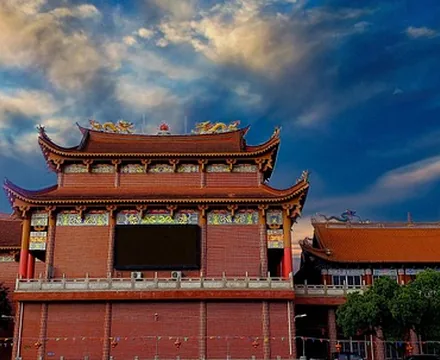
  • Address: Nanhou Street, Gulou District, Fuzhou, Fujian
  • Ticket: Free (some residences charge admission)
  • Opening: Open all day
Three Lanes and Seven Alleys
Drum Mountain & Yongquan Temple

Drum Mountain & Yongquan Temple

Recommend 4.5 / 5

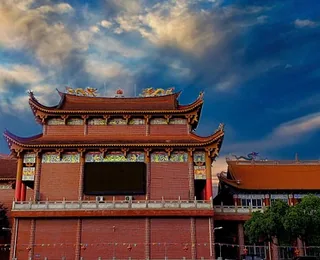
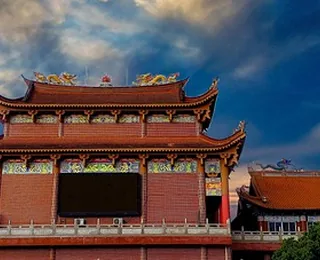
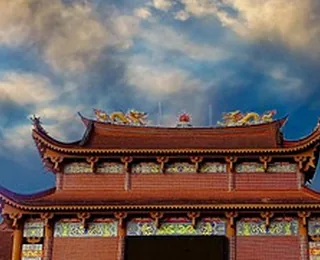
Drum Mountain rises in Jin'an district north of the city, and since Song times its paths have been pitched with stone steps, pine and bamboo closing in on either side and pavilions answering each other down the way; its “Eighteen Views” are all names left by centuries of poets and officials. Yongquan Temple was formally founded in 908 (Later Liang, Kaiping 2), when Wang Shenzhi, king of Min, invited a dharma-heir of Xuefeng Yicun to occupy its abbot's seat, and the Song court granted its name tablet; the temple takes its name from the spring that wells up from the ground on the mountain. It sits hidden in a bowl encircled by peaks, its halls climbing terrace by terrace with the slope, which produces the strange effect of the old line “you cross the mountain without seeing the temple, enter the temple without seeing the mountain,” and earned it the title “foremost temple of Fujian.” Its sutra hall preserves more than 11,000 woodblocks cut under the Song, Yuan, Ming and Qing, an unusually complete surviving set of Buddhist printing blocks, alongside a jade Buddha and a ceramic pagoda of a thousand Buddhas. Several hundred cliff inscriptions survive along the old ascent and at Lingyuan Cave and Guanshui Terrace, the Song signatures being the most prized and all scripts — seal, clerical, regular and cursive — represented, making this one of Fujian's largest collections of stone inscriptions. In 1929 the venerable Chan master Xuyun accepted the abbacy and opened a Buddhist academy here, giving the old temple a distinct place in the modern Chan lineage; today one may climb the stone steps or take the Drum Mountain cableway, and on a clear day from the summit the Min River lies below like a ribbon with the whole city in view.

Tip: Take the cable car up and walk down to enjoy the scenery along the way.

  • Address: Gushan Town, Jin'an District, Fuzhou, Fujian
  • Ticket: Free (cable car extra)
  • Opening: 07:00–17:30
Drum Mountain & Yongquan Temple
Shangxiahang

Shangxiahang

Recommend 4.6 / 5

Shangxiahang means Upper Hang Road and Lower Hang Road, near the Taijiang wharves, the centre of modern Fuzhou commerce and shipping. In the late Qing and early Republic, merchant guilds built halls and trading houses here, leaving the Gutian Guild Hall, Caifeng Villa, Santong Bridge and Xing'an Bridge. Renewal has kept the arcades and river steps while adding restaurants, bookshops and guesthouses; the night view is the draw. Highlights include the arcade night view. The birthplace of modern Fuzhou commerce, the two streets of Shangxiahang unfold along the river, with guild halls, trading houses, arcades and old residences mixed together; after renewal you look at the architecture by day and the lights by night, a good complement to the scholar-gentry character of the Three Lanes and Seven Alleys. Tip: go in the late afternoon, see the guild halls and river steps first, then eat along the river; Metro Line 1 Dadao station, about 15 minutes by taxi from the Three Lanes and Seven Alleys. Practical info: located on Shangxiahang Road, Taijiang District, Fuzhou; admission free; open all day (venues about 09:00–17:00, closed Mondays). Best season: spring (March–May) and autumn (September–November) are pleasant for exploring ancient alleys and hiking.

Tip: Go late afternoon: guild halls and river steps first, then dinner along the river.

  • Address: Shangxiahang Road, Taijiang District, Fuzhou
  • Ticket: Free
  • Opening: Open all day (venues about 09:00–17:00, closed Mondays)
Shangxiahang
Shangxiahang
Shangxiahang

Local Food

Buddha Jumps Over the Wall
¥150–300/person
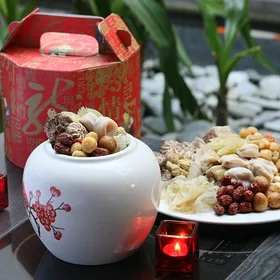
The crown jewel of Fujian cuisine — abalone, fish maw, sea cucumber and other delicacies slow-simmered into a rich, fragrant broth so enticing that legend says a Buddhist monk leapt over a wall to taste it.
★ 4.8
Fish Ball
Fish Ball
¥10–20/person
A wrapper of minced eel and fish paste surrounds a pork filling, rolled into springy, delicate balls served in clear broth — a classic Fuzhou street snack found on every corner.
★ 4.5
Meat Swallow (Rouyan)
¥10–15/person
Wrapper made from pounded meat, filled like a wonton with a bouncy texture — together with fish balls, they form Fuzhou's famed 'twin delicacies.'
★ 4.4
Pot-Side Rice Sheet Soup
¥8–12/person
Rice batter is ladled along the pot's edge to form thin sheets, then served with dried shrimp, clams, and scallions — Fuzhou's beloved savory breakfast.
★ 4.4

Culture

Fuzhou boasts deep cultural roots. The Three Lanes and Seven Alleys is one of China's best-preserved Ming–Qing street quarters, having produced modern luminaries like Lin Zexu and Yan Fu. Mawei's shipyard culture witnessed the birth of China's modern navy. Fuzhou's hot-spring wellness tradition runs deep, and Shoushan stone carving is celebrated at home and abroad. Intangible heritage such as Min opera and pinghua storytelling is kept alive here. Banyan-tree culture, shipyard culture, and hot-spring culture together shape Fuzhou's distinctive urban character.