City Intro

History & Culture: Xiamen opened as a treaty port in 1842, and in 1902 Gulangyu became an international common settlement, leaving behind its multinational architecture and overseas-Chinese memory. In 1980 it was made a special economic zone and rose from a coastal defence front to an export-oriented port city. Nanyang overseas Chinese such as Tan Kah Kee returned home to found schools and businesses, and the Tan Kah Kee spirit and the Minnan cultural line continue to this day. Xiamen's cultural heritage combines traditional Minnan culture with the atmosphere of an overseas Chinese hometown. Gulangyu's multinational architecture and piano culture merge, earning it the name 'Island of Pianos'. Nanputuo Temple has a deep Buddhist culture, and its vegetarian food and Buddhist tea are widely known. The Mid-Autumn bobing custom is distinctive and unique to Xiamen. Intangible cultural heritage such as Minnan culture, nanyin and gezi opera is passed on here, while creative areas such as Shapowei and Zengcuo'an show the fusion of modern art and the traditional fishing village.

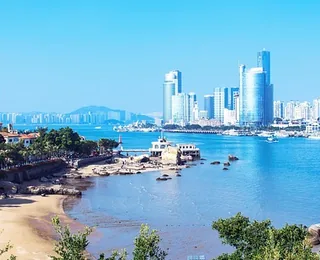
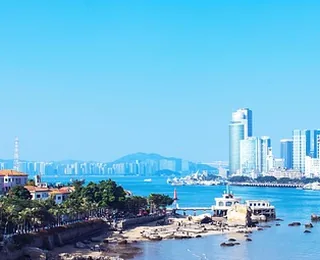
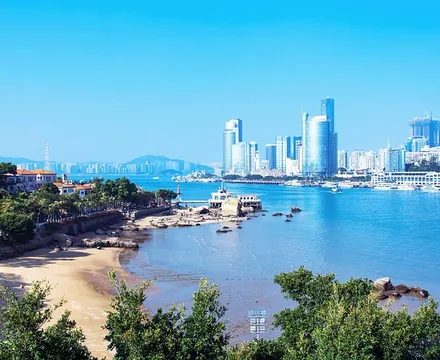
Geography: On the southeastern coast of Fujian at the mouth of the Jiulong River, facing Taiwan across the sea, Xiamen is 'a city in the sea, a sea in the city', with a mild climate like spring all year. Xiamen lies in Fujian, where landforms, rivers and climate have shaped the city's layout. Spring (Mar–May) and autumn (Sep–Nov) are mild, with flowers throughout the city, and are the best time to stroll the waterfront and islands. Natural and cultural sites are relatively concentrated, so a one- or two-day itinerary can be arranged by area. Light, vegetation and water levels change with the seasons; check the weather and scenic-area notices before setting out. Roads and railways are the main connections, and major sights can be linked from the city or county town.

Highlights: Gulangyu's multinational architecture and drifting piano music, the coconut palms and sea breeze of Huandao Road, the youthful graffiti of Xiamen University's Furong Tunnel, and the chanting at Nanputuo Temple, a busy ancient Minnan temple. Core sights include Gulangyu, Xiamen University, Nanputuo Temple and Huandao Road–Zengcuo'an. They cover history, nature and city life and can be combined freely. Pair the core sights with nearby streets, museums or food streets for a half- or full-day route. If time allows, slow down and leave room for walking and rest. First-time visitors can start with the most representative sights, then add museums, old streets or natural areas as time allows.

Food Culture: Minnan food is rich and varied: shacha noodles have a thick, mildly spicy broth, oyster omelette is crisp outside and tender inside, sea worm jelly is cool and smooth, and peanut soup is sweet and fragrant. Seafood snacks fill the streets and alleys.

Attractions

More >
Gulangyu Island

Gulangyu Island

Recommend 4.7 / 5

Gulangyu lies only a few hundred metres across the Lujiang channel from Xiamen Island and covers under two square kilometres, yet at the 41st session of the World Heritage Committee in 2017 it was inscribed on the World Heritage List as 'Gulangyu: a Historic International Community'. After the Treaty of Nanjing in 1842 Xiamen was opened as a treaty port, and Western consulates, churches, hospitals and trading houses followed onto the island; in 1902 the whole island was declared a common ground, producing an international community where overseas residents and locals lived side by side. Nearly a thousand historic buildings survive, southern Fujian red-brick mansions, colonnaded veranda houses and Western-style villas standing shoulder to shoulder. Sunlight Rock, known locally as Huangyan, is the island's high point at 92.7 metres, from which the whole island and Xiamen Bay can be taken in at once. Shuzhuang Garden was laid out in 1913 by Lin Erjia of the Banqiao Lin family of Taiwan, its name a homophone of Lin's courtesy name Shuzang, with its Forty-Four Bridge thrown over the water; the garden now houses the Piano Museum and its close on a hundred antique pianos, while the Eight Trigrams (Bagua) Building, erected in 1907 beneath its red octagonal dome, holds the Organ Museum. This small island produced generations of pianists and musicians, and its piano ownership per capita has long ranked first in China — hence its name, 'Piano Island'.

Tip: Book ferry tickets online in advance and avoid holiday crowds.
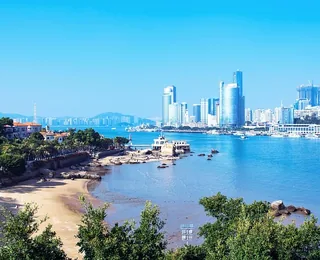
  • Address: Gulangyu, Siming District, Xiamen, Fujian
  • Ticket: Island access is free (ferry ticket sold separately, standard route ¥35); a combo ticket for the island's core sights costs about ¥90, covering Sunlight Rock, Shuzhuang Garden and Haoyue Garden — check official prices.
  • Opening: Open all day
Gulangyu Island
Gulangyu Island
Gulangyu Island
Xiamen University

Xiamen University

Recommend 4.7 / 5

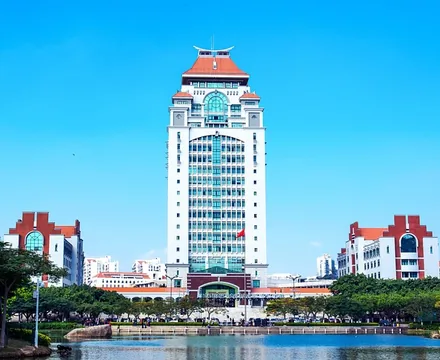
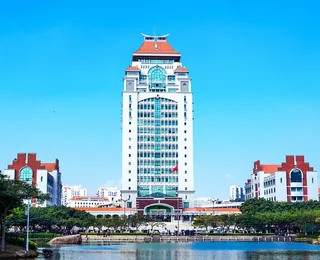
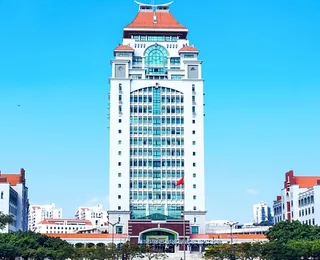
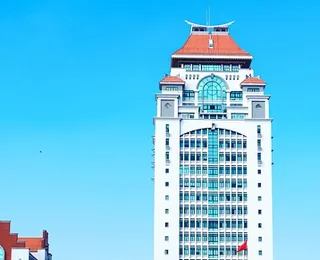
Xiamen University was prepared by the overseas Chinese leader Tan Kah Kee (Chen Jiageng) in 1919 and opened on 6 April 1921 — the first modern Chinese university founded by overseas Chinese — before being nationalised in 1937; Tan is still revered by generations of staff and students as the school's proprietor. The campus leans on Wulao Peak to the north and faces the sea at Baicheng to the south: it shares a wall with Nanputuo Temple and looks across the water to Kinmen. Its buildings show the Jiageng style summarised as 'a Western suit with a Chinese hat' — Western storeys in red brick and white stone capped by sweeping Chinese roofs: the Qunxian group of the 1920s lines up Tong'an, Jimei, Yingxue and Nangying halls, names that honour Tan's native county and overseas ties while alluding to Che Yin who studied by light from a bag of fireflies and Sun Kang who read by the glow of snow; the Jiannan and Furong groups added in the 1950s embrace Furong Lake, and in front of them Shangxian (Upper Moon) Field takes its name from grandstand and track curved like the horn of the waxing moon. The university's reputation as 'the strength of the South' was already sung in its 1921 school song. Bored through the student residential quarter, the Furong Tunnel has walls covered with graffiti made by successive classes — the most visible mark graduation season leaves on campus — and this mountain-and-sea setting is why the university is regularly hailed as one of the most beautiful in China.

Tip: Reservation required for visits. Weekend and holiday crowds are heavy.

  • Address: 422 Siming South Road, Siming District, Xiamen, Fujian
  • Ticket: Free (reservation required)
  • Opening: Visitors enter by real-name reservation (slots released daily at 08:00, 12:00 and 16:00 via the university's official WeChat account); weekday access is more restricted, weekends and public holidays freer — see official notices.
Xiamen University
Xiamen University
Xiamen University
Nanputuo Temple

Nanputuo Temple

Recommend 4.5 / 5

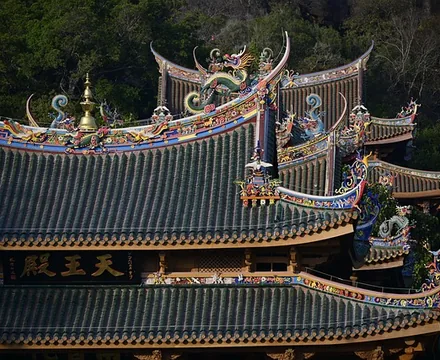
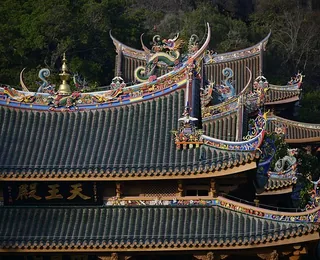
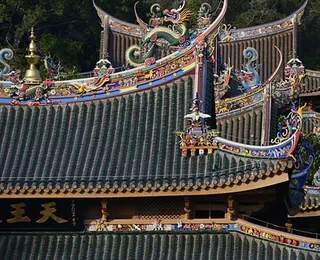
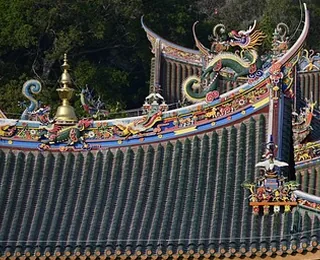
Nanputuo Temple was first built in the Tang dynasty, then fell into ruin and rose again under several different names until the Kangxi reign of the Qing, when the 'sea-pacifying marquis' Shi Lang paid for its reconstruction; because it enshrines Guanyin, as Puji Temple on Mount Putuo in Zhejiang does, it took the name 'Southern Putuo'. Along the central axis four ranges unfold in turn — the Hall of Heavenly Kings, the Mahavira Hall, the Hall of Great Compassion and the Sutra Repository — their red brick and white stone, swallowtail roof ridges and clipped-pottery mosaics displaying the best of southern Fujian craftsmanship, with the rock-garden lotus pond of Wanshi Liangchi in front and the cliff inscriptions and forests of Wulao Peak rising behind. The Sutra Repository treasures Buddhist relics including sutras written in blood and a Guanyin image painted in red ochre. In 1924 the master Taixu took charge of the temple, and in 1925 he founded the Minnan Buddhist Academy, making this one of the earliest modern Buddhist academies in China and the training ground of many eminent monks. The temple's vegetarian kitchen, which shapes southern Fujian mountain and sea ingredients into mock-meat dishes, and its Buddhist tea are celebrated far beyond Xiamen, and the path up behind the temple looks down over Xiamen University and Xiamen Harbour — the city's busiest and most venerated temple. Highlights include the vegetarian restaurant. Tip: keep quiet inside the temple and dress modestly. Practical info: located at 515 Siming South Road, Siming District, Xiamen, Fujian; free admission; opening hours 08:00–18:00.

Tip: Keep quiet inside the temple and dress modestly. Try the famous Nanputuo vegetarian food.

  • Address: 515 Siming South Road, Siming District, Xiamen, Fujian
  • Ticket: Free
  • Opening: 08:00–18:00
Nanputuo Temple
Nanputuo Temple
Nanputuo Temple

Local Food

Shacha noodles
Shacha noodles
¥20–35/person
Noodles in a broth made with shacha sauce, with seafood, tofu and duck blood — thick and mildly spicy, Xiamen's most representative noodle dish.
★ 4.7
Oyster omelette (hailijian)
¥15–25/person
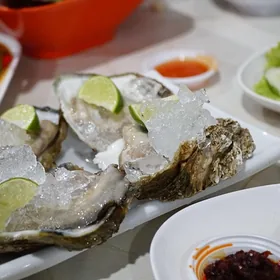
Fresh oysters pan-fried with sweet-potato starch and egg — crisp outside, tender inside and full of savoury flavour, a classic Minnan snack.
★ 4.7
Sea worm jelly (tusundong)
¥10–15/person
Made by boiling sea worms into a gelatin and chilling it, served with soy sauce, vinegar and mashed garlic — cool and smooth, a uniquely Xiamen cold dish.
★ 4.4
Peanut soup
Peanut soup
¥8–12/person
Peanuts simmered until soft and broken down into a soup — sweet, soft and fragrant; Huang Zehe's peanut soup is a classic dessert for old Xiamen residents.
★ 4.4

Culture

Xiamen's cultural heritage combines traditional Minnan culture with the atmosphere of an overseas Chinese hometown. Gulangyu's multinational architecture and piano culture merge, earning it the name 'Island of Pianos'. Nanputuo Temple has a deep Buddhist culture, and its vegetarian food and Buddhist tea are widely known. The Mid-Autumn bobing custom is distinctive and unique to Xiamen. Intangible cultural heritage such as Minnan culture, nanyin and gezi opera is passed on here, while creative areas such as Shapowei and Zengcuo'an show the fusion of modern art and the traditional fishing village.