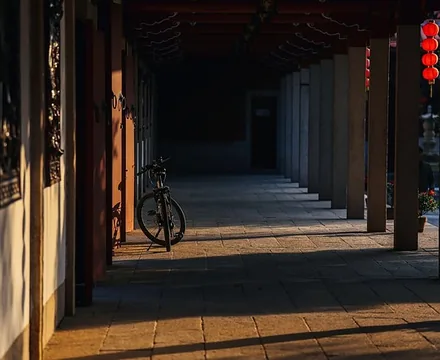
Kaiyuan Temple
Kaiyuan Temple was founded in 686, the second year of the Tang Chuigong era, first as Lotus Temple, and received its present name in 738, the twenty-sixth year of the Kaiyuan era. Tradition holds that the wealthy Quanzhou merchant Huang Shougong gave up his residence to build the temple after a mulberry tree bore white lotuses, and the plaque reading 'Mulberry-Lotus Dharma Realm' still hangs there. The twin pagodas in front of the temple define the old city skyline: the eastern Zhenguo Pagoda was first built in 865, the sixth year of the Tang Xiantong era, and the western Renshou Pagoda in 916, the second year of the Later Liang Zhenming era. Both began as timber and brick towers and were rebuilt in stone during the Southern Song, the west pagoda from 1228 to 1237 and the east from 1238 to 1250. Each is an octagonal, five-storey pavilion-style stone pagoda, the east 48.27 metres tall and the west 45.06 metres, the tallest surviving pair of stone pagodas in China. Every face carries reliefs of Buddhas, arhats, heavenly kings and vajra guardians, more than eighty figures across the two towers, and the doors and niches are offset storey by storey both to steady the structure and to guide worshippers circling the images. The main Mahavira Hall, popularly called the Hall of a Hundred Columns, is nine bays wide and six deep but stands on 86 stone columns; its beams and bracket sets carry 24 carved miaoyin birds holding musical instruments, the flying apsara musicians. Dozens of Song and Yuan Hindu mythological carvings are set into the temple walls, and the sutra library preserves a surviving fascicle of the Northern Song printed Vairocana Canon. In the 1930s the Vinaya master Hongyi, Li Shutong, stayed at Quanzhou repeatedly; in his last years he lived at the Wenling Nursing Home beside the temple and died there.
Visit in the morning to avoid the crowds.